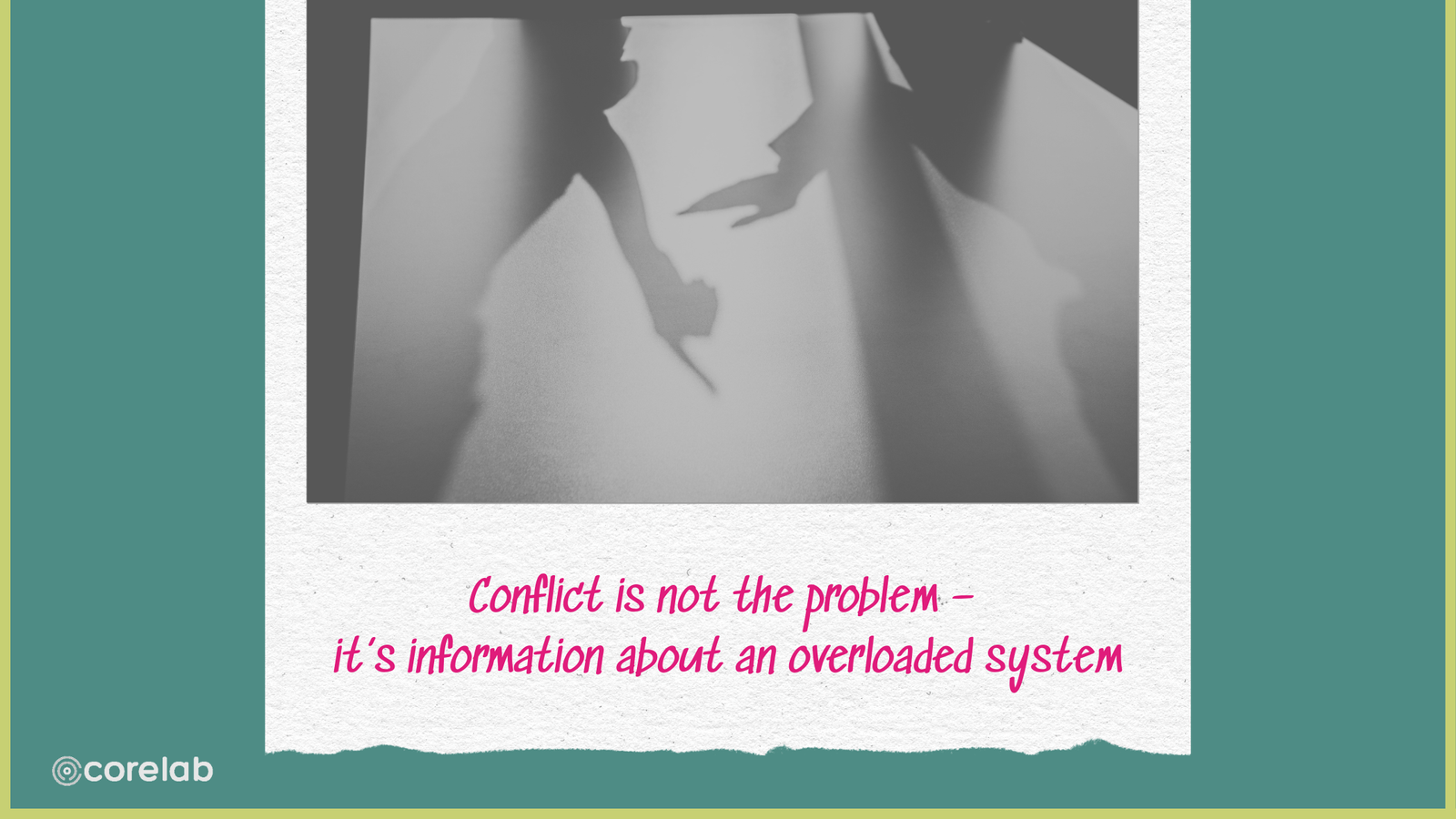

Most teams in human‑rights and feminist work are terrified of conflict. We treat it as a sign that something is broken in us, in our values, or in the people we work with. But what if conflict is not the problem – what if it is information about an overloaded system?
In many NGOs, we slip into the idea that conflict is about “who is right”: who has the better argument, the clearer politics, the more consistent anti‑oppressive language. We spend weeks arguing over a sentence in a statement, an email that felt harsh, or one person’s behaviour in a meeting. Underneath, something completely different is going on:
- chronic overload and unpaid emotional labour,
- unfair division of tasks and invisible care work,
- unspoken hierarchies between old and new staff,
- or unresolved questions about who actually decides.
If we look at conflict as a signal, the question shifts from “Who is to blame?” to “What is this conflict trying to tell us about how our system is working right now?”
Typical conflict patterns in NGOs
In feminist, migrant‑led and human‑rights organisations, certain tensions show up again and again:
- Old vs new people – Founders and long‑term staff who carry the history and trauma of the organisation, and newer people who bring fresh ideas and also question “how things have always been done”.
- Centre vs periphery – Staff in big cities vs those in smaller towns; people close to donors vs those close to communities; HQ vs local partners.
- “Local” vs “expert” – Community organisers and people with lived experience vs consultants, lawyers, researchers and international staff. Everyone says they respect each other, but in practice, some voices count more than others.
- Gender and migration tensions – Women doing most of the care and admin work while men do “high‑visibility” roles; migrants expected to share their trauma on panels while others build careers around it.
None of these conflicts means your team has failed. They mean your system is overloaded or unbalanced: too much responsibility on too few shoulders, not enough clarity about power, not enough care for the people doing the heaviest work.
From blame to curiosity: Conflict & Care Lab
This is why I developed the Conflict & Care Lab – a two‑step process for teams that want to work with conflict without shaming or breaking each other.
- Diagnostics (Conflict Scan)
Together, we take a step back and map what is actually happening in your system. We look at:- Where is the overload? Who is always “holding everything together”?
- How is work, care and emotional labour distributed?
- Where are power and decision‑making located (formally and informally)?
- What kinds of conflict keep repeating themselves?
This phase is about slowing down and getting a systemic and trauma‑aware picture of what is going on – not about deciding who is right or wrong.
- Dialogue (Conflict & Care Sessions)
Based on the scan, we design 1–3 facilitated sessions where the team can:- name key tensions in clear and non‑attacking language,
- understand how stress and trauma are shaping reactions and expectations,
- experiment with different ways of speaking, listening and deciding together,
- agree on a few concrete adjustments (around roles, communication, care, boundaries).
The aim is not a perfect harmony or a final verdict. The aim is to restore movement in stuck situations, reconnect people to the values that led them to this work, and build shared practices so that future conflicts are easier to navigate.
Conflict will not disappear – but it can become less frightening and more useful. It can serve as feedback on how your organisation shares power, work, and care.
If you feel your team is constantly tired of “the same argument again”, it may be time to stop fixing individuals and start listening to what your system is trying to tell you.